
| About 500 feet from the crossing, I slowed almost to a stop so that
I could see better what was happening on the tracks just ahead. Through
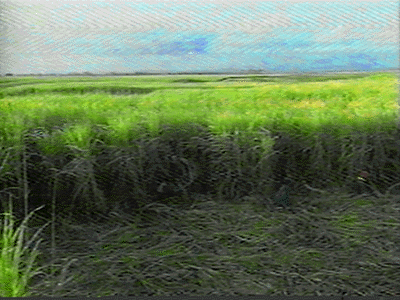
the cut blocks of sugar cane I could see hundreds of men crossing the Pan
American highway, stumbling along as they continued down the railroad tracks.
I could see several carrying rifles. My first thought was that it might
be one of the bands of communist guerillas that have been hiding in the
mountains, fighting the Guatemalan military forces for so many years. If
it were the guerillas, I would have to turn around immediately and return
to a nearby village for a while, then try to proceed a few hours later
after they had time to leave that area. I decided to get a little closer
but to remain ready to quickly turn around if necessary. I continued on
slowly.
The mass of men raised a waist-high cloud of fine dust all around them from the rich volcanic earth as they staggered onward like a herd of cattle. As I got closer to the men the sweet scent of sugar cane was quickly overcome by the putrid stench of the mass of dirty, sweat-soaked men. The choking smell of rancid sweat and dirt, mixed with vomit, made the air difficult to breathe. |
 |
| When I was within a few feet of the railroad crossing I stopped the car pretending that I had decided to wait until all the men had a chance to pass. As I had hoped, the men did not try to make way so that I could cross the tracks, which would have obliged me to do so and would have caused me to be in a more difficult position to observe the prisoners. I think the prisoners did this deliberately so that looking at them would be unavoidable. This gave me a chance to study the situation more carefully. I looked the men over quickly from head to foot, trying to take in as much detail as possible. It was then that I suddenly I realized that I had stumbled onto something that no one was ever supposed to see. It was so terrible that logic told me that I should immediately floor the accelerator and do my very best to get away before they tried to shoot me for being a witness. For a moment I looked for another chance to cross the road between the men to do just that, but there were just too many. I was definitely in the wrong place and at the worst possible time. What I saw was really disturbing. It looked like a well-orchestrated scene from a movie about prisoners at a concentration camp in Nazi Germany or Devil's Island. But it wasn't a movie, and I was sitting there in the middle of it all with my mouth hanging open and without a clue of what to do next. I froze for a moment, not knowing what to do, and felt moved at the sight of such unbelievably inhuman and cruel treatment of prisoners. It seemed incredible to me, looking at these men, to think that our own govenrment had been supporting these oppresive Guatemalan regimes financially and militarily for so many years. The U.S. Embassy must have been aware of these kinds of abuses if I could discover them so easily just by driving through the country as a tourist. | 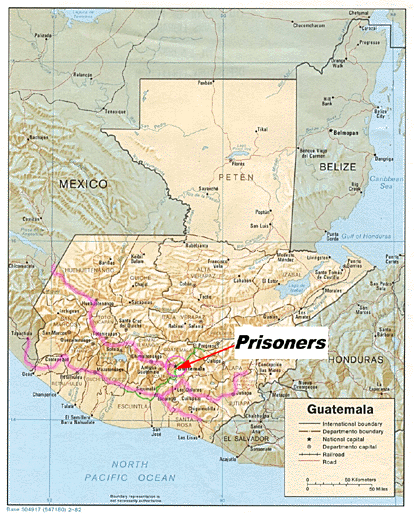 |
Just as I had seen elsewhere, these were government employees, most likely being paid with salaries financed by our generous foreign aid which even permitted the Guatemalans to maintain a heavily armed army of murderers and thieves. I couldn't understand why they needed a big army. For what? Who did they have to defend themselves against? I had noticed pictures in the government posts everywhere in Guatemala of fat, stupid looking army generals, "caras de barro"as the locals call them in Spanish, with their chests ridiculously wallpapered with all kinds of cheap medals, medals on "soldiers" from a country that has never had a real war. Any one of them with more medals than Audie Murphy and Westmoreland put together. (to be continued...)
Text Copyright © 1999
William LaRoche
This page was updated last on:
Top
| ENTER |ECHOES
| INTRODUCTION (this page)
| CONTENTS |
EMAIL
|